
If you opened a Wyoming LLC while living in Morocco, France, Belgium, Canada or anywhere else outside the United States, you were probably drawn in by the same promise as thousands of other online entrepreneurs: formation in a few days, modest annual fees, no state income tax and a good level of privacy. All of that is true. What almost nobody explained is what happens when the adventure ends.
And it often does end. The dropshipping store never took off, the freelance work changed shape, you moved countries, a partner left, or you simply realized the structure no longer fits your needs. Here is the catch: abandoning an LLC is not the same as dissolving it. Letting a company sit in a drawer means accumulating fees, filing obligations and sometimes penalties that keep arriving years after you stopped thinking about it.
This is where AccurixBooks can help. We handle your Wyoming LLC dissolution from start to finish, assisting with both the state-level dissolution and the final IRS tax filing requirements. Our goal is to make the entire process simple, affordable, and stress-free, so you can focus on your next business venture without worrying about the paperwork. Contact AccurixBooks today for professional assistance at a competitive price and close your LLC with confidence.
Why non-residents decide to dissolve their LLC
Before getting into the details, it helps to understand the most common reasons. They also help you decide whether dissolution is really the right move.
The business has stopped. This is by far the most frequent case. A web store that no longer sells, an abandoned software project, a consulting activity with no clients left. Keeping the LLC costs money for nothing.
The yearly costs weigh too much. Between the registered agent (mandatory), the state annual report and, where applicable, bookkeeping and federal tax filings, the annual bill for an LLC can quickly reach several hundred dollars. For an inactive structure, that is wasted money.
The structure no longer fits. Many non-residents discover after the fact that their tax situation at home makes a US LLC awkward or even complicated. Others prefer to move to a local company, or to another jurisdiction.
A life change. A return to your home country, a new job, the sale of the business, a split between partners. When the project evolves, the structure has to follow.
Fear of administrative risk. Some owners realize late that they have US obligations they never fulfilled. Rather than let things get worse, they want to regularize and close cleanly.
Doing nothing is not a neutral choice
Many owners think: I am not paying anything anymore, the company will eventually disappear. In practice, it is more nuanced.
In Wyoming, an LLC that fails to file its annual report and pay the associated license tax is eventually dissolved administratively by the state. That looks like a free solution, but it is not. An administrative dissolution does not erase your federal tax obligations. It does not settle the question of your EIN, your filings with the IRS, or what happens to your bank accounts and payment platforms. And it can complicate things if you ever want to reopen a company or prove that the previous one was closed properly.
Then there is the registered agent. If you stop paying the agent without arranging a replacement, the company is left without an official address for legal mail. This is exactly the kind of situation that produces unpleasant surprises.
Finally, on the IRS side, the most serious risk concerns single-member LLCs owned by a non-resident. We will come back to it below, but remember already that failing to file can lead to severe penalties, even when the company earned no revenue at all.
Before you dissolve: take stock
A well-prepared dissolution starts with an inventory. Grab a sheet of paper or a spreadsheet and list everything attached to your LLC.
- Core documents: Articles of Organization, Operating Agreement, the IRS letter confirming your EIN.
- Bank and financial accounts: US business account, neobank accounts, Stripe, PayPal, Wise, payment gateways.
- Platforms tied to the company: Amazon, Shopify, app stores, ad networks, online services billed to the LLC.
- Ongoing contracts: subscriptions, domain names, vendors, customers.
- Debts and receivables: unpaid invoices, upcoming refunds, possible disputes.
- Assets: cash in the bank, inventory, intellectual property, domains, social media accounts.
- Past filings: did you file the Wyoming annual report every year? Form 5472 with the IRS? If not, write it down: you will need to regularize.
This inventory is what separates a smooth dissolution from a path full of surprises. It also stops you from closing the company while forgetting an account or a contract that will keep billing you.
The steps to dissolve a Wyoming LLC
The process can vary depending on your file, but the same main steps almost always appear.
Step 1: The decision to dissolve
The first step is internal. If your LLC has a single member, the decision is yours. If there are several members, follow what the Operating Agreement says: majority, unanimity, voting procedure. Even for a single-member LLC, it is wise to write a short resolution recording the decision to dissolve. It costs nothing and serves as useful evidence if a bank or an authority asks for proof.
Step 2: Settle the ongoing affairs
The company must clear its commitments before it disappears: pay suppliers, collect receivables, cancel contracts, close subscriptions. Remaining assets are then distributed to the members, according to their shares or what the agreement provides. Keep a written record of everything, in particular transfers between the company account and your personal account.
Step 3: Get up to date with the State of Wyoming
Before filing the dissolution, it is generally advised to be in good standing with the state, meaning you have filed any annual reports due and paid the corresponding license tax. In Wyoming this tax is proportional to the assets held in the state, with a minimum that was $60 the last time I checked. Confirm the current amount on the Secretary of State website, because fee schedules can change.
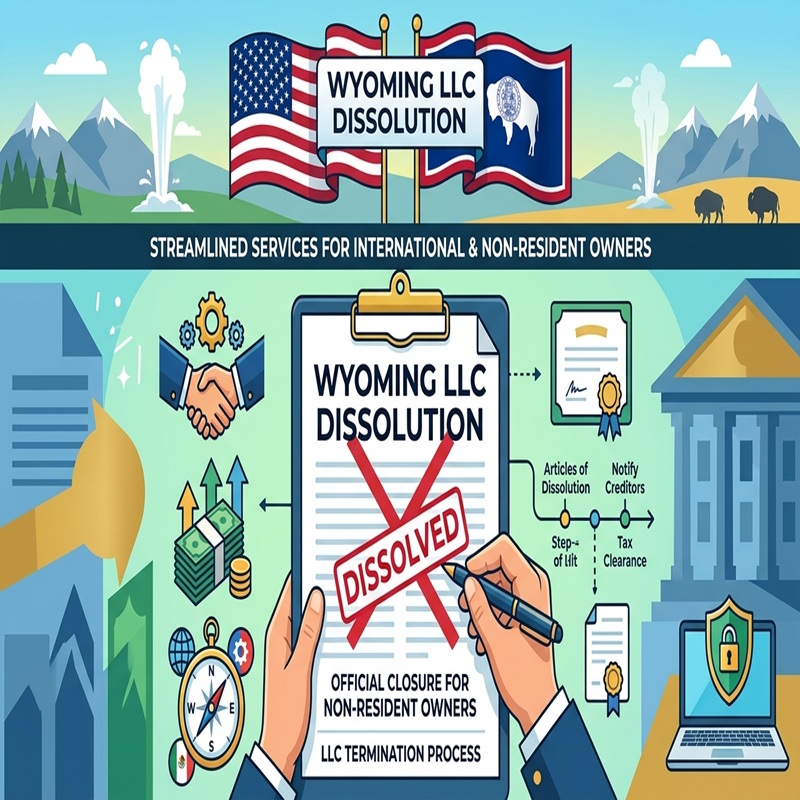
Step 4: File the Articles of Dissolution
This is the heart of the procedure. It is the official document filed with the Wyoming Secretary of State to record the end of the LLC’s existence. It can be filed online through the state portal or by mail. It typically includes the company name, the date of the decision to dissolve and contact details. The filing fee was $60 at my last check, again to be confirmed before you proceed.
Once the filing is accepted, you receive confirmation from the state. Keep it carefully, in digital form and backed up in several places: it is your proof that the company is dissolved.
Step 5: The federal tax side
This is the most sensitive step for a non-resident, and the one many people neglect.
An LLC owned by a single person, where that owner is a foreigner, is by default treated as a disregarded entity for income tax. But the IRS still requires, in most cases, an annual Form 5472 attached to a pro forma Form 1120. This form reports transactions between the company and its foreign owner. The penalty for a missing or incomplete form is heavy, in the order of $25,000 per form per year.
In a dissolution, you generally must file a final return for the current year, marking it as the last one. If you have years that were never filed, they need to be regularized, which is a classic reason to get help from a professional. Situations vary greatly depending on whether the company had activity, US-source income or employees.
Step 6: Close the EIN and the accounts
The EIN is not deleted as such, but you can ask the IRS to close the associated business account by writing to them once all returns are filed. On the banking side, close the business account after transferring the remaining funds. Do the same for Stripe, PayPal, Wise Business and other financial services. Keep the closing statements.
Step 7: Plan for the registered agent
Once the dissolution is accepted, you can end the contract with your registered agent. Do not do it before the state confirms: as long as the company exists, it must have one. Simply notify the agent, and check that there will be no billing after the dissolution date.
How much does it cost?
The costs depend on your starting point. Here are the main items to plan for:
- Filing the Articles of Dissolution: about $60 in state fees, to be confirmed.
- Late annual report or license tax: at least $60 for each year due, more if assets in the state are high.
- Registered agent: usually a few dozen up to around a hundred dollars a year, payable until dissolution.
- IRS filings: the cost depends on who prepares them. An accountant familiar with foreign-owned LLCs costs more than a simple filing, but it prevents heavy mistakes.
- Dissolution service fees: variable, from a few dozen to several hundred dollars depending on what is included.
The cheapest scenario is an LLC that is up to date, inactive, and dissolved quickly. The most expensive is a company abandoned for several years with missing filings. Hence the value of not waiting.
A dissolution service for non-residents: what is it really for?
You can do all of this yourself, and some people do it very well. But a dissolution service specialized in non-residents brings several concrete advantages.
It knows the procedures. A provider used to Wyoming dissolutions knows which documents to prepare, in what order, and how to avoid filing rejections over formatting details.
It handles the distance. Between time zones, language and the lack of a US address, remote paperwork can be tiresome. The service acts as your local contact.
It can coordinate the tax side. Some providers work with accountants who prepare the Form 5472 and the final return. Others limit themselves to the Wyoming part, which is a crucial difference.
It saves you time. For someone who does not want to spend evenings reading IRS instructions, delegating has real value.
It delivers a closing file. The best services give you a complete package at the end: dissolution confirmation, copies of the filings, certificates. It is useful for your bank or your local tax authority.
How to choose the right provider
Not all services are equal. Here are the questions to ask before paying:
- What exactly does the price include? State filing only, or the IRS part as well?
- Are state fees included or billed on top?
- Do you have experience with non-resident owners? It is common sense, since the tax stakes differ.
- What is the announced timeline, and what happens if a filing is rejected?
- What if I have years of missing filings? Do they handle the catch-up, or send you elsewhere?
- What support is there after dissolution? Do you receive a file of proofs?
- Is the provider transparent about who they are, their address and their customer reviews?
Be wary of rock-bottom offers that do not say what they include. If the price looks too good, it is often because the tax part is not covered.
Do it yourself or delegate: how to decide
There is no single answer, but a few markers help.
Do it yourself if your LLC never had activity or very little, all your obligations are up to date, you are comfortable with online procedures in English and you have time to double-check every point.
Delegate if you have several members, years of late filings, multiple bank accounts, an activity with significant revenue or US customers, or you simply want peace of mind. In these cases, the cost of a service is often lower than the cost of a mistake.
The most common mistakes
Across non-resident files, the same errors come back again and again.
Terminating the registered agent too early. Without an agent the company is in default, which can complicate the dissolution filing.
Forgetting Form 5472. This is the most expensive mistake. Even an inactive company can have a reporting obligation.
Confusing administrative and voluntary dissolution. The first is a sanction by the state; the second is a clean procedure that gives you a clear record.
Leaving accounts open. An active PayPal or Stripe account in the name of a dissolved company can create compliance and security problems.
Not keeping proof. Your bank, a future partner or your tax authority may ask for evidence of dissolution years later.
Ignoring your local tax situation. This is the big forgotten one. Just because the company is American does not mean your country of residence ignores what it generated.
And in your country of residence?
Dissolving the LLC does not stop at the US border. Depending on where you live, you may have reported the LLC’s income on your personal return, or declared holding accounts and shares in a foreign company. You may therefore need to report the end of that holding, declare the closure of overseas accounts and treat the distribution of remaining funds correctly.
These rules vary widely from one country to another. The safest course is to consult a local accountant or tax adviser and show them the dissolution file. It is often the last piece of the puzzle, and the one people tend to postpone.
Frequently asked questions
Can a Wyoming LLC be dissolved entirely remotely?
Yes. State procedures can be completed online with no physical presence. You simply need to provide the requested information and sign the documents.
How long does it take?
The state filing can be processed within a few business days. The overall timeline then depends on preparing your file, the tax returns and closing the accounts. Allow a few days to a few weeks for a simple case.
What if my LLC was already administratively dissolved?
It depends on the situation. In some cases you can reinstate it and then dissolve it voluntarily to regularize things. In others, you focus on the tax part. A professional can guide you.
Do I still have to file anything after dissolution?
For the State of Wyoming, no, once the dissolution is accepted. For the IRS, you must file the final return for the relevant year and regularize any missing years if needed.
Can I open a new LLC later?
Yes, you can form a new company at any time. A clean history makes things easier, particularly with banks.
Can a service do everything for me?
That depends on the provider. Most can handle the state filings. The IRS part and your local tax obligations are often handled separately, which is why reading the offer carefully matters.
Closing properly means protecting yourself
Dissolving a Wyoming LLC as a non-resident is not insurmountable, but it is not a formality to take lightly either. Between state requirements, IRS obligations and the implications in your country of residence, several layers stack on top of each other. The idea of simply letting the company fade away is tempting, but it often leaves behind tax obligations, needless fees and zones of uncertainty.
The right approach comes down to a few principles: take inventory of what exists, get current with the state, handle the federal tax side, file the Articles of Dissolution, close the accounts and keep the proof. Whether you do it alone or with a specialized service, the key is to leave no gray area.
If your file is simple, you can probably go ahead on your own, checking every amount and every rule against official sources. If it is more complex, the support of a dissolution service for non-residents, ideally linked to a competent accountant, is an investment that quickly pays for itself.
Either way, do not wait. Every year without a proper closure is another year of fees and added risk. Closing an LLC cleanly lets you turn the page calmly and start your next project on solid ground.