
If you’ve spent more than ten minutes googling this question, you’ve probably noticed something annoying: every article seems to give a different answer. One says Wyoming. Another swears by Delaware. A third says Nevada is a tax haven. And your cousin who runs a landscaping business says just use your home state and stop overthinking it.
Here’s the honest truth: there is no single best state to start an LLC for everyone. But there is a best state for you, and it usually comes down to three or four simple questions. This guide walks through them in plain language, compares the most popular options with real numbers, and helps you land on an answer you can feel confident about.
Need help choosing the right state for your LLC? At AccurixBooks, we help entrepreneurs and non-U.S. residents navigate LLC formation, EIN applications, registered agent services, and ongoing compliance requirements. Whether you’re launching your first U.S. business or looking to simplify your existing setup, we help you understand your options, avoid unnecessary costs, and take the right steps from day one. Let AccurixBooks help you build your U.S. business with confidence.
The Short Answer: Which State Is Best for an LLC?
If you want the quick version, here it is:
- Most small businesses operating in one state: form your LLC in the state where you actually live and work. It’s usually the simplest and often the cheapest overall.
- Online businesses, freelancers and non-US founders with no physical presence in the US: Wyoming and New Mexico are popular for low costs and minimal ongoing paperwork.
- Startups planning to raise investor money: Delaware is the standard, because investors and their lawyers know it well.
- Businesses that want strong privacy and don’t mind higher fees: Nevada and Wyoming both offer solid options, though Nevada costs noticeably more.
Now let’s get into the why, because the right choice depends on how your business actually works.
Why the State You Pick Matters (and When It Doesn’t)
An LLC is created at the state level. When you form one, you’re registering it with a specific state, and that state’s rules decide your filing fee, your yearly costs, how much public information is shown about you, and which courts and laws apply to your company.
But here’s the part many guides skip: your LLC’s tax treatment is mostly federal. A standard single-member LLC is taxed as a “disregarded entity” by default, meaning profits flow through to your personal tax return. Picking a state doesn’t magically erase that.
And there’s an even bigger catch. If you form your LLC in one state but actually do business in another, you’ll generally need to register your LLC as a “foreign LLC” in the state where you operate. That means paying two sets of fees instead of one. This single fact is why the “just form it in Wyoming” advice backfires for so many people who live and work in California, New York or Texas.
So the real question isn’t “which state has the lowest fees?” It’s: where does my business actually operate, and what do I need from it?
The 6 Factors That Should Drive Your Decision
1. Where you live and operate
If you have a physical office, employees, inventory or customers concentrated in one state, that state’s rules will apply to you no matter where the LLC is registered. In this case, forming in your home state usually keeps things clean: one state, one set of annual filings, one set of fees.
2. Formation and annual costs
The sticker price of filing is only half the story. Some states have low formation fees but charge annual taxes or fees that add up fast. Others charge more upfront but ask for very little afterward. Always compare the total first-year cost and the ongoing yearly cost.
3. State taxes
Some states have no state income tax, which can matter if your LLC is taxed as a pass-through. Others charge franchise taxes, gross receipts taxes or flat annual fees regardless of whether you made money. If you’re just starting out and profits are small, a flat annual fee can hurt more than a percentage-based tax.
4. Privacy
In most states, the names of LLC members or managers can end up in public records. Some states are friendlier to privacy than others. If you don’t want your home address and name floating around in a public database, this matters. Many founders also use a registered agent address to keep their home address off the record.
5. Legal environment and asset protection
Delaware is famous for its business courts and predictable body of law. Wyoming and Nevada have strong asset-protection reputations, including stronger protections against certain creditor claims. For most small businesses these differences are theoretical, but they can matter for investors, holding companies and higher-risk ventures.
6. Your long-term plans
Are you building a small side income, a consulting practice, a real estate portfolio, or a venture-backed startup? The answer changes the recommendation. A quiet freelance business and a company planning to raise a seed round have very different needs.
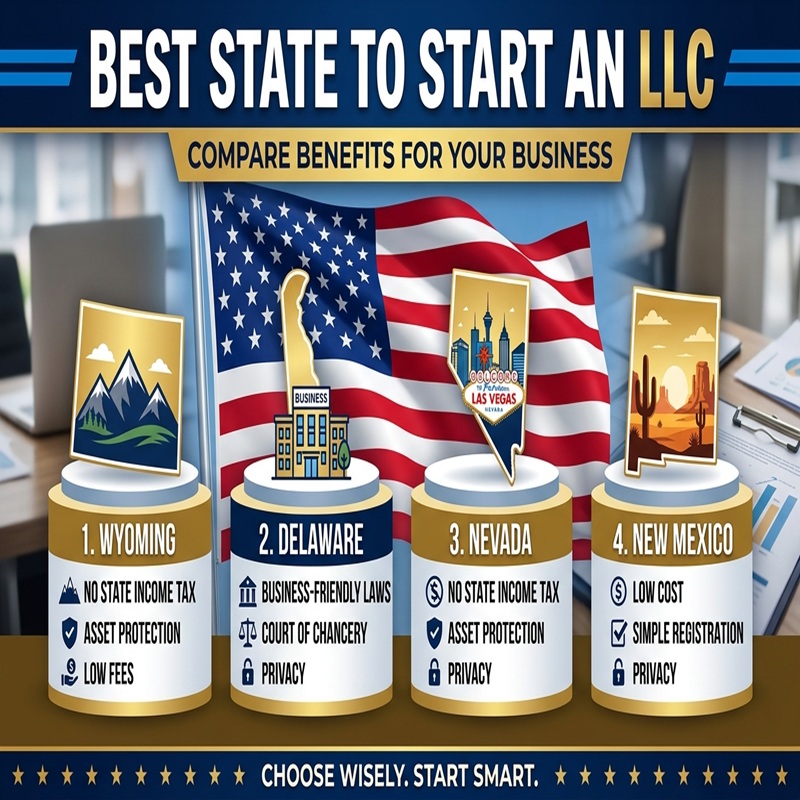
Best States to Start an LLC: Side-by-Side Comparison
Here’s a quick snapshot of the most popular choices. These figures are approximate and based on commonly published state fees; always confirm on the official Secretary of State website before filing.
| State | Approx. formation fee | Approx. ongoing yearly cost | State income tax | Best for |
| Wyoming | $100 | $60 minimum annual report | None | Online businesses, low-cost setups, privacy |
| New Mexico | $50 | $0 (no annual report) | Yes, but LLC owners pass through | Lowest ongoing cost, simple setups |
| Delaware | $110 | $300 annual tax | Not on out-of-state income | Startups, investors, complex structures |
| Nevada | $75 plus initial list and license (about $425 total) | About $350 | None | Privacy-minded owners who accept higher fees |
| Texas | $300 | No annual fee, but franchise tax reporting | None personal | Businesses based in Texas |
| Florida | $125 | About $139 annual report | None personal | Businesses based in Florida |
| California | $70 | $800 minimum franchise tax | High | Only if you operate there |
Let’s look at each one honestly, including the downsides most blogs gloss over.
Wyoming: The Favorite for Low Costs and Simplicity
Wyoming has become the go-to answer for online entrepreneurs, and there are good reasons for it.
What’s great about it:
- Low filing fee and a very low yearly cost.
- No state income tax.
- Strong privacy options, since members and managers aren’t required to be listed publicly in the same way as in many other states.
- Strong asset protection laws, including favorable rules around charging orders.
- A straightforward, business-friendly filing process that can be done online.
What to watch out for:
- If you live or operate in another state, you’ll probably still need to register as a foreign LLC there. That erases a lot of the savings.
- Wyoming doesn’t have the investor recognition that Delaware has.
Best fit: freelancers, e-commerce sellers, consultants, bookkeepers and other online service providers with little or no physical presence in a high-fee state, and many non-US founders.
New Mexico: The Quiet Budget Option
New Mexico doesn’t get as much attention, but it’s one of the cheapest states to form an LLC in and keep one alive.
What’s great about it:
- Very low filing fee.
- No annual report requirement, which means no yearly filing fee and no deadline to forget.
- Simple, low-maintenance compliance.
What to watch out for:
- Less name recognition than Wyoming or Delaware.
- The same foreign-registration issue applies if you actually operate elsewhere.
Best fit: side businesses and small online operations where keeping yearly costs near zero is the priority.
Delaware: The Standard for Startups and Investors
Delaware is the state most big companies choose, and it has a reputation to match. Its Court of Chancery is a specialized business court, and its corporate and LLC law is well developed and predictable.
What’s great about it:
- Investors, lawyers and acquirers are comfortable with Delaware entities.
- Flexible LLC law and strong contract freedom.
- A very respected legal system for resolving business disputes.
- No Delaware state income tax on income earned outside the state for companies that don’t operate there.
What to watch out for:
- A flat annual tax of about $300 for LLCs, due every year regardless of profit.
- You’ll still need a registered agent in Delaware, which adds a recurring cost.
- If you operate elsewhere, you’ll need to register as a foreign LLC in that state too.
Best fit: founders who plan to raise outside capital, bring on partners, or eventually convert to a corporation. If you’re just a solo freelancer, Delaware is usually more cost and paperwork than you need.
Nevada: Privacy and No Income Tax, at a Price
Nevada attracts a lot of attention because of its no-income-tax status and privacy reputation, but it’s worth being realistic about its cost.
What’s great about it:
- No state income tax.
- Strong asset protection laws.
- Good privacy options for owners who want less public exposure.
What to watch out for:
- Higher fees than Wyoming, New Mexico or Delaware: the initial filing, initial list and state business license add up quickly, and you’ll pay a similar amount every year.
- Nevada has a commerce tax that applies to businesses with high gross revenue.
- If you don’t operate in Nevada, you’ll likely pay Nevada fees and your own state’s fees.
Best fit: owners who actually live or operate in Nevada, or those who place a high value on its privacy and asset-protection reputation and are comfortable with the cost.
Texas: A Strong Pick If You’re Already There
Texas has no personal income tax and a famously business-friendly reputation.
What’s great about it:
- No state personal income tax.
- Large, growing economy with plenty of opportunity.
- No annual LLC fee, though you must file an annual franchise tax report.
- Small businesses under the revenue threshold generally owe no franchise tax.
What to watch out for:
- The filing fee of $300 is higher than in many other states.
- Franchise tax reporting is still required every year, even if you owe nothing.
Best fit: anyone based in Texas. If you aren’t, there’s usually no reason to form here.
Florida: Simple, Affordable and Popular
Florida is a common choice for small businesses, freelancers and real estate investors.
What’s great about it:
- Reasonable filing fee and a modest annual report fee.
- No state personal income tax.
- Easy online filing and a large small-business community.
What to watch out for:
- Late annual reports trigger a steep penalty, so missing the May 1 deadline is costly.
- Privacy is more limited, since annual report information is public.
Best fit: Florida residents and businesses operating in Florida.
California and New York: Usually Not a Choice
These two states deserve a mention because they’re where a lot of people end up making an expensive mistake.
California charges an $800 minimum franchise tax every year, whether or not your LLC earns anything. If you do business in California, you owe it even if your LLC is registered in Wyoming or Delaware. Forming elsewhere won’t get you out of it.
New York has a unique publication requirement: new LLCs must publish a notice in newspapers, which can cost anywhere from a few hundred to well over a thousand dollars depending on the county.
If you live and work in either state, forming there is typically the right and legally cleaner move, even though the costs sting. Trying to dodge them through another state tends to add cost rather than remove it.
Best State to Start an LLC for Non-US Residents
A lot of searchers are entrepreneurs living outside the US who want a US company to sell online, accept payments from American clients, or build credibility. If that’s you, the picture is a little different.
Because you don’t live or operate in a US state, you don’t have a “home state” pulling you toward one. That’s why Wyoming, New Mexico and Delaware come up most often:
- Wyoming and New Mexico for low cost and low maintenance.
- Delaware if you’re thinking about investors or a more traditional startup path.
A few important points for non-US founders:
- You’ll need a registered agent with a physical US address in your chosen state.
- A US LLC owned by a non-US person with no US business activity generally has no US income tax, but it still has federal reporting requirements (for example, Form 5472 with a pro forma Form 1120 for foreign-owned single-member LLCs). Missing these filings can bring heavy penalties.
- You’ll typically need an EIN from the IRS, and opening a US bank account can take extra effort, though several online banking and payment platforms work with foreign-owned LLCs.
- Your own country’s tax rules still apply to you personally. A US LLC doesn’t remove your tax obligations at home.
This is one area where a quick consult with a CPA who understands cross-border tax is worth the money.
The Hidden Cost Most Guides Skip: Foreign Qualification
Let’s come back to the biggest trap, because it’s worth repeating.
Suppose you live in Illinois, run your consulting business from your kitchen table, and form an LLC in Wyoming because someone online said it’s cheaper. In the eyes of Illinois, you’re doing business in Illinois. So you’d need to register your Wyoming LLC as a foreign LLC in Illinois, pay Illinois fees, and file Illinois annual reports. You’d also keep paying Wyoming’s fees and your registered agent.
Result: two states, double the paperwork, and higher total costs than if you’d formed in Illinois to begin with.
A good rule of thumb: form where you physically operate. Only choose a different state if you have a clear reason, such as investor requirements or having no US presence at all.
How to Choose: A Simple Decision Framework
Run through these questions in order:
- Do you live and work in the US? If yes, start with your home state. Compare it to alternatives only if you have a specific reason to look elsewhere.
- Are you planning to raise venture or angel funding? If yes, Delaware is usually the practical choice.
- Do you operate online with no physical presence in the US, or live abroad? Look closely at Wyoming and New Mexico, and consider Delaware.
- Is privacy a major priority? Compare Wyoming and Nevada, and consider using a registered agent to keep personal details off the public record.
- Do you want the lowest possible ongoing cost? New Mexico and Wyoming lead here.
If you still feel torn, add up the real first-year cost for your top two states: filing fee, registered agent, annual fees, and any foreign registration you’d need. The cheaper option on paper isn’t always the cheaper option in practice.
Step-by-Step: How to Start Your LLC Once You’ve Chosen a State
Every state has its own forms, but the process is broadly similar everywhere:
- Choose a business name that’s available in your state and includes “LLC” or an accepted variation.
- Appoint a registered agent with a physical address in the state, available during business hours to receive legal documents.
- File your Articles of Organization (called a Certificate of Formation in some states) with the Secretary of State and pay the filing fee.
- Create an operating agreement. Even where it isn’t legally required, it protects you and documents how the business is run.
- Get an EIN from the IRS. It’s free to apply directly through the IRS.
- Open a business bank account to keep personal and business finances separate. That separation is a big part of keeping your liability protection intact.
- Stay compliant by filing annual reports, paying franchise taxes or fees, and meeting federal reporting requirements on time.
Many founders choose a formation service to handle the paperwork, which can save time and reduce mistakes, especially for non-US owners or multi-state situations.
Common Mistakes to Avoid
- Choosing a state based only on the filing fee. Annual costs and foreign registration often matter more.
- Ignoring where you actually operate. Your physical location and customers drive your obligations.
- Skipping the operating agreement. It’s easy to put off and painful to lack when something goes wrong.
- Mixing personal and business money. This can weaken the liability protection you formed the LLC to get.
- Missing annual deadlines. Late fees, penalties and even administrative dissolution can follow.
- Assuming a US LLC erases your home-country taxes. It doesn’t.
Frequently Asked Questions
What is the cheapest state to start an LLC?
New Mexico is typically the cheapest overall, thanks to a low filing fee and no annual report. Wyoming is a close second with a low formation fee and a small yearly report fee. Kentucky and a few other states also have low upfront costs, but check each state’s ongoing requirements.
Is Wyoming really the best state for an LLC?
It’s excellent for the right situation, namely online businesses with no strong ties to a high-fee state. It’s not automatically best for everyone. If you live and work in another state, forming locally is often simpler and cheaper overall.
Should I form my LLC in Delaware?
Choose Delaware if you plan to bring in investors, issue different classes of ownership, or eventually convert to a corporation. For a solo freelancer or small local business, it’s usually extra cost without extra benefit.
Can I form an LLC in a state where I don’t live?
Yes, you can. But if you operate in your home state, you’ll normally also need to register as a foreign LLC there. That means paying fees in both states.
Do I need a registered agent?
Every state requires one. You can act as your own agent if you have a physical address in the state and are available during business hours, or you can hire a commercial registered agent for an annual fee, which also helps with privacy.
Which state is best for LLC privacy?
Wyoming and Nevada are often cited for privacy, and New Mexico is also strong because it doesn’t require disclosure of members or managers on formation documents. Using a registered agent address also helps keep your personal address out of public records.
Can a non-US resident own a US LLC?
Yes. There are no citizenship or residency requirements to own an LLC in any state. You’ll need a registered agent, an EIN, and to follow US federal reporting rules for foreign-owned LLCs.
Can I change my LLC’s state later?
You can, but it takes work. Usually it means forming a new LLC or going through a conversion or domestication process, plus updating your bank, contracts and licenses. It’s much easier to choose carefully at the start.
Final Thoughts: Pick the State That Fits Your Reality
The internet loves a simple answer, but the real answer to “what’s the best state to start an LLC?” is: the one that matches how and where you actually run your business.
If you live and work in one state, form there. If you’re building an online business with no US footprint, Wyoming and New Mexico are hard to beat on cost and simplicity. If you’re chasing investors, Delaware is the safe, familiar choice. And if privacy is your top priority, compare Wyoming and Nevada with open eyes about the price tag. Take an hour to add up the real, all-in costs for your top two options, check the official state websites for current fees, and talk to a CPA or attorney if your situation is complex. Get this decision right now, and it’ll quietly save you time, money and headaches for years to come