
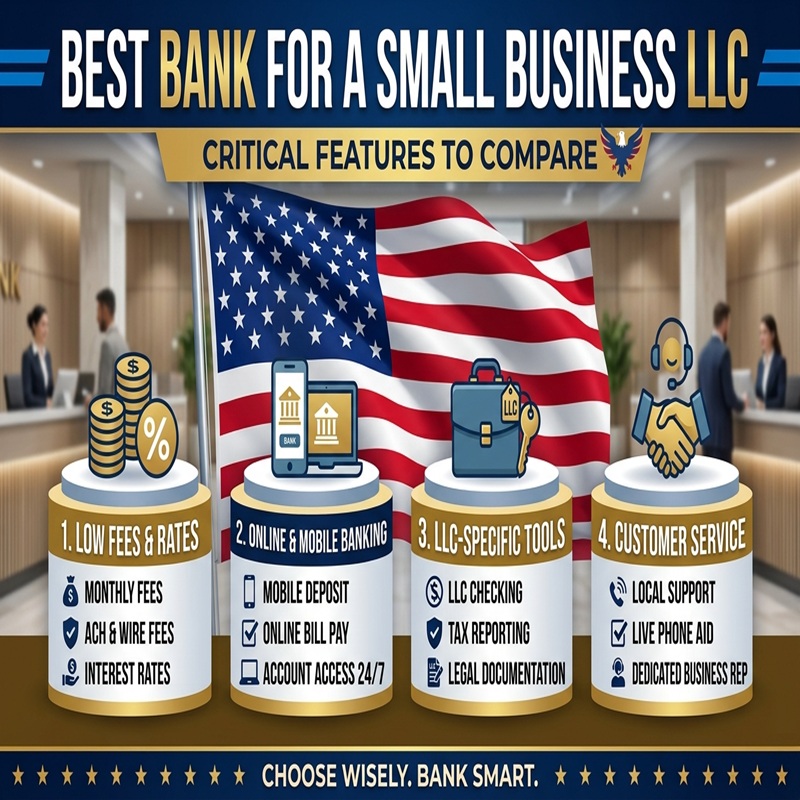
The best bank for a small business LLC depends on how you actually run your money: online-first startups, cash-heavy local shops and non-US founders each need a different account.
At AccurixBooks, we help entrepreneurs open business bank accounts with many of these banking providers after forming their LLC, guiding them through the application process and helping them choose an option that fits their business needs.
The Best Banks for an LLC at a Glance
For most new LLC owners, an online business account such as Mercury, Relay, Bluevine or Novo is the best starting point, while Chase or Bank of America make sense if you need branches and cash deposits.
If you just want the short version, here is how the most popular options compare. Fees and promotions change often, so treat these figures as approximate and confirm them on each bank’s own website before you apply.
| Bank | Best for | Monthly fee | Minimum balance | Branches |
|---|---|---|---|---|
| Mercury | Online startups, freelancers, tech-first founders | $0 | $0 | No |
| Relay | Teams, budgeting and multiple accounts | $0 on the basic plan | $0 | No |
| Bluevine | Earning interest on a business balance | $0 on the standard plan | $0 | No |
| Novo | E-commerce sellers and solo owners | $0 | $0 | No |
| Chase Business Complete Checking | In-person banking and cash deposits | About $15, waivable | About $2,000 daily balance to waive | Yes |
| Bank of America Business Advantage | Large branch and ATM network | About $15, waivable | Varies by plan | Yes |
No single account wins for everybody. The right pick depends on three things: whether you handle physical cash, whether you want to bank entirely from your phone, and whether you’re based in the US. The rest of this guide walks through each of those so you can choose with confidence.
Why Your LLC Needs Its Own Bank Account
If you’ve just formed an LLC, you might be tempted to keep using your personal checking account “for now.” Plenty of new owners do it. It’s also one of the quickest ways to undo the main reason you formed an LLC in the first place.
An LLC protects your personal assets from business debts and lawsuits, but only if the company is treated as a genuinely separate entity. When business and personal money get tangled together, a court can decide the two are effectively the same thing, which is often called “piercing the corporate veil.” A dedicated business account is the simplest, cheapest evidence that your LLC is a real, separate business.
There are practical reasons too:
- Cleaner bookkeeping. Every transaction in the account is a business transaction. Your bookkeeper or accountant won’t have to untangle a grocery run from a software subscription.
- Easier tax time. Clear records make it far simpler to separate deductible expenses from personal spending and to back them up if you’re ever questioned.
- Credibility. Customers, payment processors and platforms often expect to pay or be paid by an account in the company’s name, not in yours.
- Simpler loans and credit. Lenders and card issuers like to see a real banking history for the business.
One caution: opening the account is not a legal formality that can be skipped later. Do it as soon as you have your EIN and formation documents, and keep personal spending out of it from day one.
What to Look for in a Business Bank Account for Your LLC
The most important thing to look for is how much the account will really cost you once you read past the headline. Banks are very good at advertising “free” accounts that come with strings attached, so here is what actually deserves your attention.
Monthly fees and how to waive them
Many traditional banks charge around $15 a month for a basic business checking account and offer to waive it if you keep a certain balance or hit a spending target. That sounds harmless until your cash flow dips in a slow month and you’re suddenly paying fees for nothing. Online banks have largely removed this problem by charging nothing at all for their standard accounts.
Minimum balance requirements
A minimum balance can quietly lock up money you might need for payroll, inventory or taxes. If your income is irregular, a $0 minimum is worth more than a fancy rewards program.
Cash deposits and branch access
This is the question that splits the market in two. If you run a salon, a food stand or any business that handles physical cash, you’ll want a bank with branches or a cash deposit network. If you invoice clients online and get paid by transfer or card, a branchless bank is usually all you need.
Integrations with your accounting software
A bank feed that connects cleanly to QuickBooks or Xero saves hours every month. Bad feeds, or no feed at all, mean manual entry and mistakes. Check that your bank connects to the software you already use.
Interest on your balance
Some accounts now pay interest on business balances, though the rate often depends on conditions or a linked savings product. It’s a nice bonus for keeping a cash cushion, but it shouldn’t outweigh fees or usability.
FDIC insurance
Deposits at online banks are typically insured through partner banks, and the standard insurance limit is $250,000 per depositor per bank. If you plan to hold more than that, look at how the account handles extra coverage.
Payments, cards and international transfers
Check wire fees, ACH limits, debit and virtual cards, and whether you can accept payments from overseas clients. If you work with customers abroad, the cost of receiving international money can matter more than the monthly fee.
Customer support
When something goes wrong with your business account, you want a real person to answer. Online banks vary a lot here, so look at how you can reach support and how quickly.
Best Banks for Small Business LLCs: Honest Reviews
Each of the options below suits a different kind of owner. I’ve tried to be straight about the downsides too, because every account has some.
Mercury: best for online-first startups and freelancers
Mercury is a financial technology platform, not a bank itself. Its accounts are provided through partner banks and are FDIC-insured through them. It charges no monthly fee, has no minimum balance and keeps its interface clean and modern, which is why so many startups and remote founders choose it.
Pros: no monthly fees, no minimum balance, free domestic transfers, strong integrations with accounting tools, and a simple dashboard that makes it easy to give a bookkeeper access.
Cons: no physical branches and no way to deposit cash directly, so it’s a poor fit for cash-heavy businesses.
Best fit: software companies, consultants, agencies and freelancers who do everything online.
Relay: best for teams and organized budgeting
Relay is popular with owners who like to split money into separate accounts for taxes, payroll, profit and operating costs. Its basic plan has no monthly fee or minimum balance, and you can open multiple checking accounts under one login.
Pros: multiple accounts for budgeting, easy team permissions, good accounting integrations.
Cons: it’s another branchless option, and some of the more advanced features sit behind paid plans.
Best fit: small teams and owners who want envelope-style money management.
Bluevine: best for earning interest on your balance
Bluevine offers a business checking account with no monthly fee on its standard plan and the possibility of earning interest, although the rate usually depends on meeting certain conditions.
Pros: interest potential, no monthly fee, a solid mobile experience.
Cons: interest requirements can change, and cash deposits go through retail partners, which can add fees.
Best fit: owners who keep a healthy cash cushion and want it to earn something.
Novo: best for e-commerce sellers
Novo is built around online sellers and solo operators. It connects with platforms such as Shopify, Stripe and Amazon, and its standard account charges no monthly fee and has no minimum balance.
Pros: easy platform integrations, no monthly fees, simple setup.
Cons: like other online accounts, it has no branches and limited cash handling.
Best fit: Shopify, Etsy and Amazon sellers, plus freelancers who want to keep things simple.
Chase Business Complete Checking: best for branches and cash
Chase is the largest US bank by assets, and that scale shows in its branch and ATM network. Business Complete Checking typically carries a monthly fee of around $15, which can be waived by keeping a minimum daily balance (often $2,000) or meeting other qualifying activity.
Pros: huge branch and ATM network, easy cash deposits, in-person help, and frequent new-account bonuses.
Cons: the monthly fee unless you qualify for a waiver, limited interest on balances, and extra fees for certain transactions beyond the included limits.
Best fit: local, cash-based businesses and owners who value being able to walk into a branch.
Bank of America Business Advantage: best for a large traditional presence
Bank of America also offers a broad branch and ATM network and a range of business account tiers. Fees and waiver thresholds vary by plan, so read the fee schedule carefully before you commit.
Pros: wide branch coverage, a full range of business products including credit and lending, and strong online banking.
Cons: monthly fees unless you meet balance or activity requirements, and rules that differ by account tier.
Best fit: owners who want everything under one large bank, including loans and credit down the road.
Best Bank for an LLC Owned by Someone Outside the US
If you live outside the US, your best option is usually an online bank or fintech platform that explicitly accepts foreign-owned LLCs, because most traditional banks want you to walk into a branch in person.
This is one of the most common situations among online entrepreneurs: you formed a US LLC in a state like Wyoming, Delaware or New Mexico, you have an EIN, and now you need somewhere to receive payments from American clients. A few things are worth knowing before you start.
- Policies differ and change. Some online banks accept non-US owners with a passport and proof of address, while others require a US address, a Social Security number or an ITIN. Read the eligibility requirements on each bank’s site before you apply.
- Expect more documents. You’ll typically be asked for your LLC’s formation documents, EIN confirmation letter, operating agreement and a valid passport. Some banks also want a description of your business and proof that you operate legitimately.
- Applications can take longer. Foreign-owned accounts often get extra review, and a vague business description is a common reason for delays or rejections.
- Consider a multi-currency account too. Platforms built for international payments can reduce the cost of receiving money in dollars and moving it to a local account, which sometimes matters more than the checking account itself.
- Keep your US filings in order. A foreign-owned US LLC has federal reporting obligations even if it owes no US income tax, so make sure your bookkeeping is accurate from the very first transaction.
The practical move is to shortlist two or three online banks that accept foreign-owned LLCs, compare their fees and requirements, and apply to your first choice with complete, clean documents. If one declines you, try another rather than giving up: different banks have different risk policies.
How to Choose the Right Bank in Five Questions
You can narrow the field in a few minutes by answering five honest questions about how your LLC works day to day.
- Do you handle physical cash? If yes, lean toward Chase, Bank of America or another bank with branches. If no, an online bank will probably serve you better and cost less.
- Are you based in the US? If you’re outside the country, start with online banks that accept foreign-owned LLCs and skip the ones that require an in-person visit.
- How steady is your income? If your revenue swings from month to month, avoid accounts with balance requirements to waive fees. A $0 minimum is safer.
- Which tools do you rely on? Make sure the bank connects smoothly to your accounting software, payment processor and e-commerce platform.
- Will you need credit or a loan soon? If you expect to apply for financing in the next year or two, a bank with lending products can make that easier, though many online banks also partner with lenders.
If two accounts still look equal, pick the one with the simplest fee schedule. The cheapest account on paper isn’t always the cheapest in practice once you add wire fees, cash deposit fees and charges for going over transaction limits.
How to Open a Business Bank Account for Your LLC
Opening an LLC bank account usually takes under an hour of your time if you have your paperwork ready. Here is the process from start to finish.
Documents you’ll typically need
- Your LLC’s formation document (Articles of Organization or Certificate of Formation)
- Your EIN confirmation letter from the IRS
- Your operating agreement
- A government-issued photo ID for each owner (a passport for non-US owners)
- Your personal address and, for some banks, proof of address
- A short description of what your business does and how it earns money
Some banks also ask for an ownership breakdown if your LLC has more than one member, since they are required to identify the people behind a company.
Step-by-step
- Shortlist two or three banks using the questions above.
- Gather your documents and make sure the name on each one matches your LLC’s legal name exactly. Small mismatches are a common cause of delays.
- Apply online or in person. Online banks usually let you apply from your phone or laptop and verify your identity digitally.
- Answer the business questions honestly. Describe your services clearly, and say where your customers and revenue come from.
- Fund the account if a deposit is required, and set up online access, cards and any team permissions.
- Connect your accounting software so transactions flow into your books from the first day.
- Set a simple rule: business money in, business expenses out, and nothing personal in between.
Common Mistakes When Choosing an LLC Bank Account
Most banking problems for small LLCs come from a handful of avoidable mistakes. Here are the ones that cause the most pain.
- Choosing on the welcome bonus alone. A $300 bonus feels great, but it doesn’t offset years of monthly fees or a balance requirement that strains your cash flow.
- Ignoring the fee schedule. The marketing page says “free.” The fee schedule says what happens when you send a wire, deposit cash or exceed a limit. Read the second one.
- Using your personal account “just for now.” It weakens the separation your LLC depends on and makes your bookkeeping far harder.
- Applying with mismatched details. The business name, address or owner information that differs between your documents and your application can trigger delays or a rejection.
- Putting everything in one bank. Online banks are convenient, but a single point of failure is risky. Keeping a backup account or a second bank for emergencies is a sensible habit.
- Forgetting FDIC limits. If you hold large balances, check how deposits are insured and whether your total exposure is covered.
- Skipping the accounting connection. A bank that doesn’t sync with your books turns every month-end into a manual chore.
- Assuming you can’t switch. You can change banks later. It takes effort, but a bad fit isn’t a life sentence.
Frequently Asked Questions
What is the best bank for a small business LLC?
There isn’t one answer for everyone. Online banks like Mercury, Relay, Bluevine and Novo are strong picks for low fees and easy digital banking, while Chase and Bank of America suit owners who need branches and cash deposits.
Does an LLC need a business bank account?
Legally, the rules vary by situation, but in practice you should always have one. A separate account protects your limited liability status, keeps your records clean and makes tax time much easier.
Can I use my personal bank account for my LLC?
You can technically move money through a personal account, but it’s a bad idea. Mixing funds makes it harder to prove your LLC is a separate entity and can weaken the protection you formed it to get.
What documents do I need to open an LLC bank account?
Usually your formation documents, your EIN letter, your operating agreement and a government ID for each owner. Banks may ask for extra details about your business, especially if you’re a non-US owner.
Can a non-US resident open a US business bank account for an LLC?
Often yes, but it depends on the bank. Many online banks accept foreign-owned LLCs, while traditional banks may require you to appear in person or have a US address. Always check each bank’s eligibility rules first.
Which LLC bank account has no monthly fees?
Several online accounts, including Mercury, Relay’s basic plan, Bluevine’s standard plan and Novo, advertise no monthly fees and no minimum balance. Confirm the current fee schedule before you apply, since terms can change.
Is an online bank safe for my LLC?
Most online business banks work with FDIC-insured partner banks, which means deposits are insured up to the standard limit. Look at how the platform describes its insurance and who the partner banks are.
Do I need an EIN to open a business bank account?
In most cases yes. An EIN identifies your LLC for tax purposes and is a standard requirement for opening a business account, though a few banks accept a Social Security number for single-member LLCs.
Can I have more than one business bank account?
Yes, and many owners do. Separate accounts for taxes, payroll and operating expenses make budgeting easier and help protect money you owe the government.
Can I switch banks later?
Yes. You’ll need to update your payment details, move recurring payments and reconnect your accounting software, but switching is straightforward if your current bank stops serving you well.
Pick the Account That Fits How You Work
The best bank for your small business LLC is the one that matches how your business actually earns and spends money. If you work online, an account like Mercury, Relay, Bluevine or Novo will likely save you money and time. If cash and face-to-face service matter, Chase or Bank of America are worth the monthly fee or balance requirement. And if you’re outside the US, focus on online banks that clearly accept foreign-owned LLCs.
Whichever you choose, open the account early, keep business and personal money apart, and connect it to your bookkeeping from day one. That small habit protects your liability shield, makes tax season far calmer and gives you a clear picture of how your business is really doing.